
Carbon Credit Lifecycle: From Project to Retirement
Carbon Credit Lifecycle: From Project to Retirement
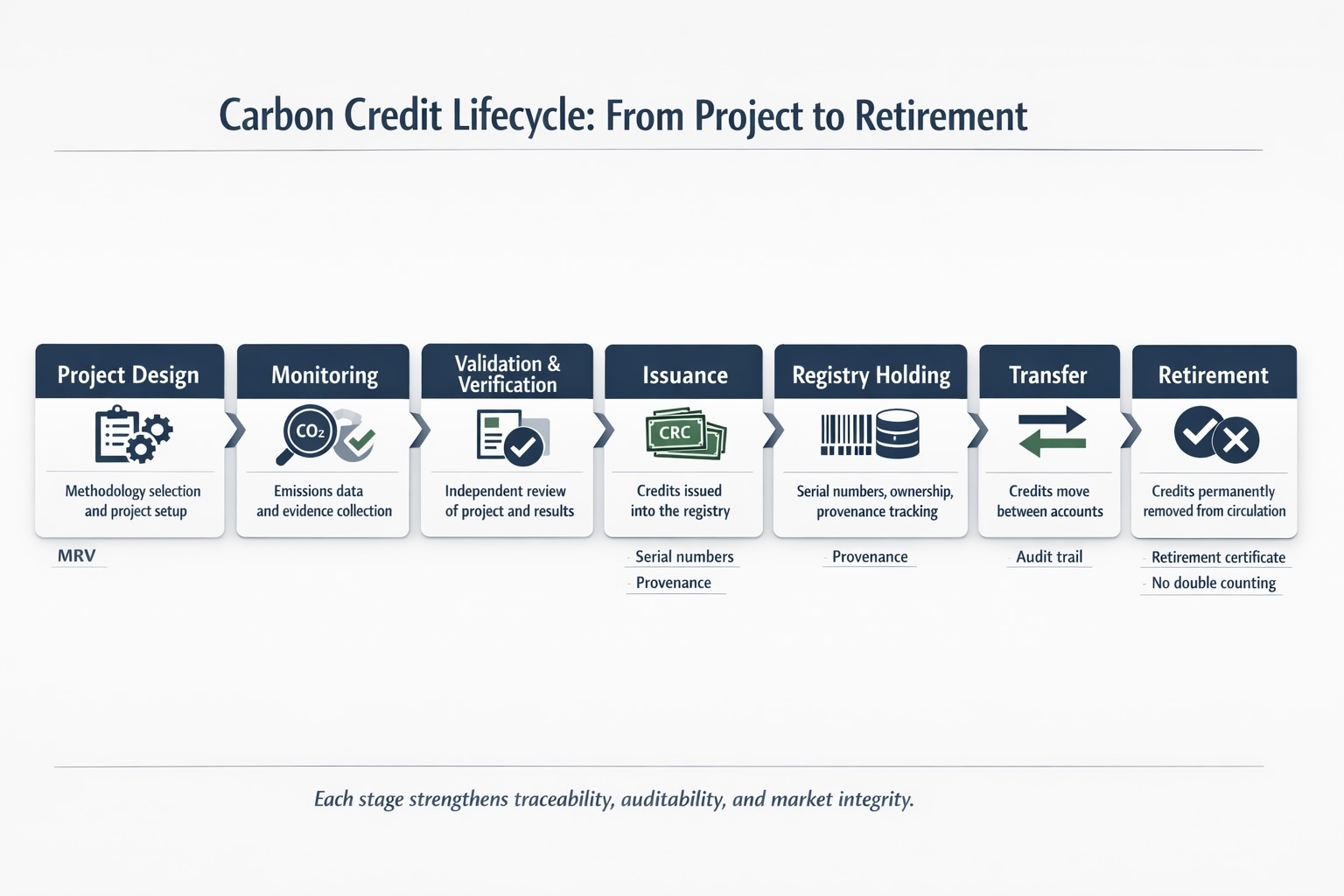
The carbon credit lifecycle starts long before a unit appears in a registry. A carbon credit only becomes credible when a project is designed under a recognised methodology, monitored over time, independently verified, issued into a registry, transferred through accountable ownership records, and finally retired so it can no longer be traded or claimed again.
Summary: If you want to understand how carbon credits work, the key is to follow the chain step by step: project development, monitoring, verification, issuance, registry holding, transfers, and retirement. Each stage exists to protect traceability, prevent double counting, and give buyers confidence that a credit is real, unique, and used only once.
Why the lifecycle matters
A carbon credit is not simply created because a project claims climate impact. It has to move through a controlled process that turns reported emissions reductions or removals into a traceable environmental asset.
That process matters because carbon markets rely on more than environmental ambition. They rely on evidence, chain of custody, and credible retirement records. Gold Standard describes the registry as the place where products such as carbon credits are “issued, held, transferred, and retired,” and notes that unique serial numbers allow full traceability through the lifecycle of the credit. Verra similarly ties issuance to registry account holders and requires credits to be uniquely numbered and transparently listed. [oai_citation:1‡Gold Standard](https://www.goldstandard.org/impact-registry)
In practice, that means the lifecycle is not administrative detail. It is the mechanism that makes a carbon credit governable, tradable, and auditable.
The carbon credit lifecycle at a glance
- Project design and registration
- Monitoring and data collection
- Independent validation and verification
- Credit issuance into a registry
- Holding and transfer between accounts
- Retirement against a claim or obligation
The exact rules vary by program, project type, and jurisdiction. But the broad flow is remarkably consistent across serious market systems. The World Bank’s country guidance treats credit generation, issuance, transfer infrastructure, and institutional arrangements as linked questions rather than isolated tasks. [oai_citation:2‡Open Knowledge Database](https://openknowledge.worldbank.org/bitstreams/5e509041-47b3-479d-83b1-201ec976df99/download)
Step 1: project design and registration
The lifecycle begins with a project or program that is intended to reduce, avoid, or remove greenhouse gas emissions. This could be a forest conservation activity, a clean cooking program, a methane capture project, a renewable energy intervention, or a soil carbon initiative.
At this stage, the project developer typically has to choose a recognised methodology and prepare the documentation that explains how reductions or removals will be quantified. In established systems, projects are then registered under a standard or mechanism before credits can be issued later. Verra’s Verified Carbon Standard is one of the main programs used for this purpose, and Gold Standard likewise uses a registry structure to track certification status and resulting credits. [oai_citation:3‡Verra](https://verra.org/programs/verified-carbon-standard/)
This first stage matters because weak project design creates downstream risk. If baseline assumptions, eligibility rules, or monitoring boundaries are poorly defined, later issuance becomes harder to defend.
Step 2: monitoring and data collection
Once a project is underway, the next phase is monitoring. This is the operational layer where the project collects the evidence needed to support a future carbon credit claim.
Depending on the project type, monitoring might include field measurements, meter readings, sampling, satellite data, fuel records, land-use records, engineering calculations, or structured surveys. What matters is not just that data exists, but that it can be traced back to the monitoring approach defined at the start.
In well-run systems, this stage already anticipates future verification. Records are retained, assumptions are documented, and evidence is organised in a way that can later support an audit trail.
Step 3: independent validation and verification
Before credits are issued, the project and its reported outcomes usually have to pass independent review.
Validation checks whether the project design and methodology application meet program requirements. Verification checks whether the claimed emissions reductions or removals are supported by evidence for a specific reporting period.
Verra’s quality assurance principles state that projects must contract an approved validation and verification body and that reductions or removals must be quantified according to program requirements. That is one of the most important controls in the lifecycle because it creates a layer of independent scrutiny between project claims and market issuance. [oai_citation:4‡Verra](https://verra.org/programs/verified-carbon-standard/vcs-quality-assurance-principles/)
Quoted source: Verra says credits must be “uniquely numbered and transparently listed.” That short phrase captures why verification and registry controls are inseparable: the market needs both credible quantification and visible asset tracking.
Step 4: issuance into the registry
Once a reporting period has been verified, the program can issue credits into the registry. This is the point at which a verified climate outcome becomes a formal carbon market asset.
Issuance does a few things at once. It creates a quantity of credits tied to a project and reporting period. It assigns those credits to a registry account. It records the issuance event in the system of record. And it makes those units available to be held, transferred, or eventually retired.
Verra explains that Verified Carbon Units are issued to registry account holders listed on the Verra Registry. Gold Standard’s Impact Registry describes the registry as the source of truth for products, including credits, once they are issued. [oai_citation:5‡Verra](https://verra.org/programs/verified-carbon-standard/verified-carbon-units-vcus/)
This is also where serialisation becomes critical. Credits need unique identifiers or serial ranges so that each unit can be tracked across its lifecycle.
Step 5: serial numbers and provenance
One of the most misunderstood parts of the carbon credit lifecycle is serialisation. Carbon credits are not meant to float around as vague quantities. They are meant to exist as uniquely identifiable units or blocks of units inside a registry.
Gold Standard states that unique serial numbers are generated for every issued credit and that these serial numbers allow full traceability from generation to sale and eventual use or retirement. Verra’s quality assurance material makes the same point differently by requiring credits to be uniquely numbered and transparently listed. [oai_citation:6‡Gold Standard](https://www.goldstandard.org/impact-registry)
This is what gives a credit provenance. Provenance is the documented history of where a credit came from, how it was issued, who has held it, and whether it has already been used. Without provenance, buyers are being asked to trust an asset without being able to inspect its lineage.
Step 6: holding and transfers between accounts
After issuance, credits can be held in registry accounts and transferred between participants. This is the stage most people associate with carbon trading, but it only works because the earlier stages created traceable units in the first place.
Transfers may happen because a project developer sells credits to a broker, because an intermediary sells to a corporate buyer, or because credits move between internal accounts before retirement. In each case, the registry should record the movement clearly so ownership history remains intact.
Gold Standard’s registry description is useful here because it does not treat transfer as a secondary function. It explicitly includes credits being held and transferred as part of the registry’s core role. That is a reminder that the lifecycle does not stop at issuance. The market still needs controlled custody after the credit is created. [oai_citation:7‡Gold Standard](https://www.goldstandard.org/impact-registry)
Step 7: retirement
Retirement is the final step in the lifecycle. It is the point at which a credit is permanently taken out of circulation.
Credits are retired when an entity wants to use them for a claim, an internal target, a compliance obligation, or another recognised purpose. Once retired, the credit should no longer be transferable or available for another buyer to use.
This matters because retirement is the mechanism that prevents double claiming. A carbon credit only has environmental credibility if the market can show that once it is used, it is no longer active.
Gold Standard’s registry materials are especially clear on this point. They present retirement as part of the normal lifecycle, not as an optional administrative extra. The World Bank’s Carbon Assets Tracking System also reflects this broader logic by describing the registry as supporting issuance and transactions of emission reduction units, rather than simply storing static data. [oai_citation:8‡Gold Standard](https://www.goldstandard.org/impact-registry)
What retirement records and certificates are meant to prove
In many market systems, retirement is accompanied by a retirement record or certificate. This typically identifies the project, the quantity retired, the relevant serial numbers or serial range, the date of retirement, and the account or entity associated with the action.
The purpose is simple: to create a clear, auditable record that the credit has been used and cannot be used again. For buyers, that is often the key evidence supporting an external claim. For regulators and auditors, it is a control against double counting and duplicate use.
A market without reliable retirement records may still look active, but it will struggle to support serious scrutiny.
Why lifecycle integrity matters more than ever
As carbon markets mature, more attention is shifting from the existence of credits to the quality of the systems behind them. The World Bank’s guidance for countries makes clear that infrastructure, institutional arrangements, and regulatory design are part of the carbon market question from the start. That is because lifecycle integrity determines whether a market can scale without losing credibility. [oai_citation:9‡Open Knowledge Database](https://openknowledge.worldbank.org/bitstreams/5e509041-47b3-479d-83b1-201ec976df99/download)
This is also why infrastructure platforms matter. If project records, MRV, verification, registry issuance, transfers, and retirement live in disconnected places, the chain becomes harder to trace and defend. But if those stages are linked in a coherent operating system, the entire lifecycle becomes easier to govern.
Where platforms like CarboGrid fit
For CarboGrid’s category of product, the strategic value is not just in showing carbon credit data. It is in supporting the full lifecycle in a more controlled way: from project workflows and verification through registry operations, transfers, retirement, and audit trails.
That matters for governments, registries, market operators, and enterprises alike. The better the lifecycle is connected, the easier it becomes to defend provenance, maintain trust, and support credible market participation.
Conclusion
If you want to understand how carbon credits work, the most useful place to start is the lifecycle itself.
A credit begins with project design, moves through monitoring and verification, becomes a formal asset at issuance, remains traceable through serial numbers and transfers, and ends with retirement. Every step exists for a reason. Together, they create the controls that make a carbon credit real, unique, and usable only once.
That is why the lifecycle is not just educational background. It is the operating logic of the market.
Sources
- World Bank, Country Guidance for Navigating Carbon Markets — https://openknowledge.worldbank.org/bitstreams/5e509041-47b3-479d-83b1-201ec976df99/download
- World Bank, Carbon Assets Tracking System (CATS) — https://cats.worldbank.org/
- Verra, Registry Overview — https://verra.org/registry/overview/
- Verra, Verified Carbon Units (VCUs) — https://verra.org/programs/verified-carbon-standard/verified-carbon-units-vcus/
- Verra, VCS Quality Assurance Principles — https://verra.org/programs/verified-carbon-standard/vcs-quality-assurance-principles/
- Gold Standard, Impact Registry — https://www.goldstandard.org/impact-registry
- Gold Standard, Registry Functionality — https://www.goldstandard.org/registry-functionality